
The Power of Earned Value: Why Your Project’s "Health" Is More Than Just a Date

The Power of Earned Value: Why Your Project’s "Health" Is More Than Just a Date
In the world of project management, we often ask two simple questions: Are we on time? and Are we on budget? However, answering these independently can be misleading. You might be under budget simply because you haven’t started the work yet. To get the real story, you need Earned Value Management (EVM).
Originally developed by the U.S. Navy in 1941 as a way to track complex progress, EVM is the "truth-teller" of project management. It stops you from guessing and starts letting the math speak for itself.
The Mechanics: How Value is "Earned"
At its core, Earned Value (EV) is developed by extrapolating the budgeted cost of resources and matching that against the time those resources spend developing and completing their tasks. It assigns a literal dollar value to your physical progress.
Let’s look at a simple example:
- The Resource: One team member.
- The Cost: $20 per hour.
- The Task: A 5-hour job.
- Budgeted Cost of Work Planned (BCWP): $100.
If your project plan dictates you have five days to complete this task, each day represents 20% of the value. When you accomplish that specific amount of work, you have officially "earned" that portion of the budget.
The Math of the "Red Zone"
On Day 1, you state you have completed 20%. Your Earned Value is $20 and your baseline work schedule was $20. You have an earned value index of 1.0. You are perfectly on track.
However, if by Day 2 you don’t record any additional progress, you are still at 20% complete. But according to your plan, your value should have been 40% ($40).
The Reality Check: Your earned value is still $20, but your baseline budget says it should be $40. Your progress is now 0.5.
In professional project management, anything below 0.8 should be considered "In the Red." This indicates that it will now take a significant adjustment of project effort to "catch up."
The Conundrum: The Cost of Catching Up
When you fall behind, you face a choice. If you work extra hours to catch up by the Friday deadline, you spend more money than was budgeted. The only way out of this trap is often working on a fixed-bid basis, where you might spend 12 hours a day to catch up without increasing the project cost.
Consider the "Friday Finish" scenario:
By Friday night, your scheduled value is $100. But you have only accomplished $80 worth of work. You are behind schedule. To fix this, you bring in an additional resource to finish the job. That resource costs an extra $20.
Now, you have spent $120 to accomplish $100 worth of work. Your earned value for this effort is 0.8—which, in a nutshell, is Red.
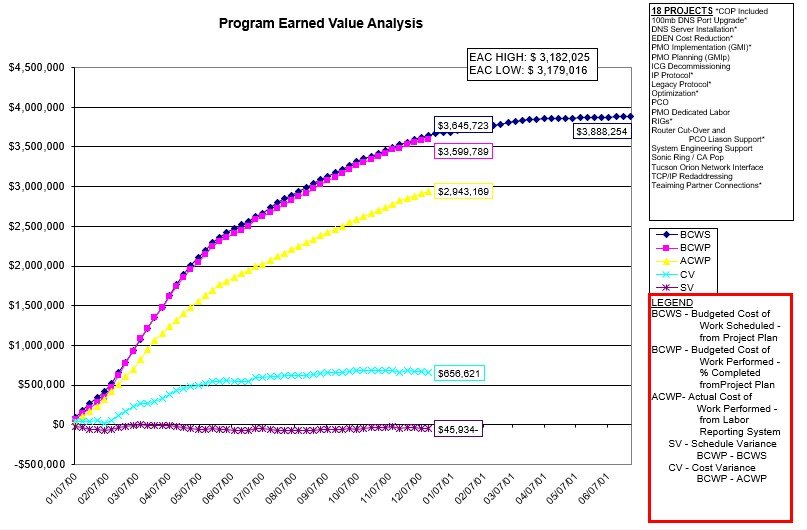
Immediate Visibility at Scale
When you extrapolate this math across dozens, hundreds, or even thousands of line items in a complex WBS, you get an immediate, undeniable view of the project's health. EVM provides the data necessary to see over-budget trends or schedule delays the moment they happen, rather than waiting until the end of the month to realize the project is sinking.
Don't just track hours; track value.
Earned Value Legend
- BCWS: Budgeted Cost Work Scheduled - This is the budget for the project, extrapolated across the project schedule.
- BCWP: Budgeted Cost Work Performed - This is the cost of the registered work performed per the project schedule
- ACWP: Actual Cost Work Performed - Regardless of what the project says, this is the cost of the actual hours clocked by the resource. The Variance here could be that the project plan assigned 4 hours to a task, but the resource actually spent 6 hours completing the task.
- SV: Schedule Variance: BCWS - BCWP - The difference the work scheduled to complete, and the work actually updated in the project plan
- CV: Cost Variance: BCWP-ACWP - This is the money maker. The difference between cost-work completed in the plan, and the cost-work actually paid for. Marking a task complete in the plan is theoretical. What you actually paid, or moreso, what you're actually getting billed for really dictates money spent. If a project is running long, you can lower cost by bringing in less expensive resources.